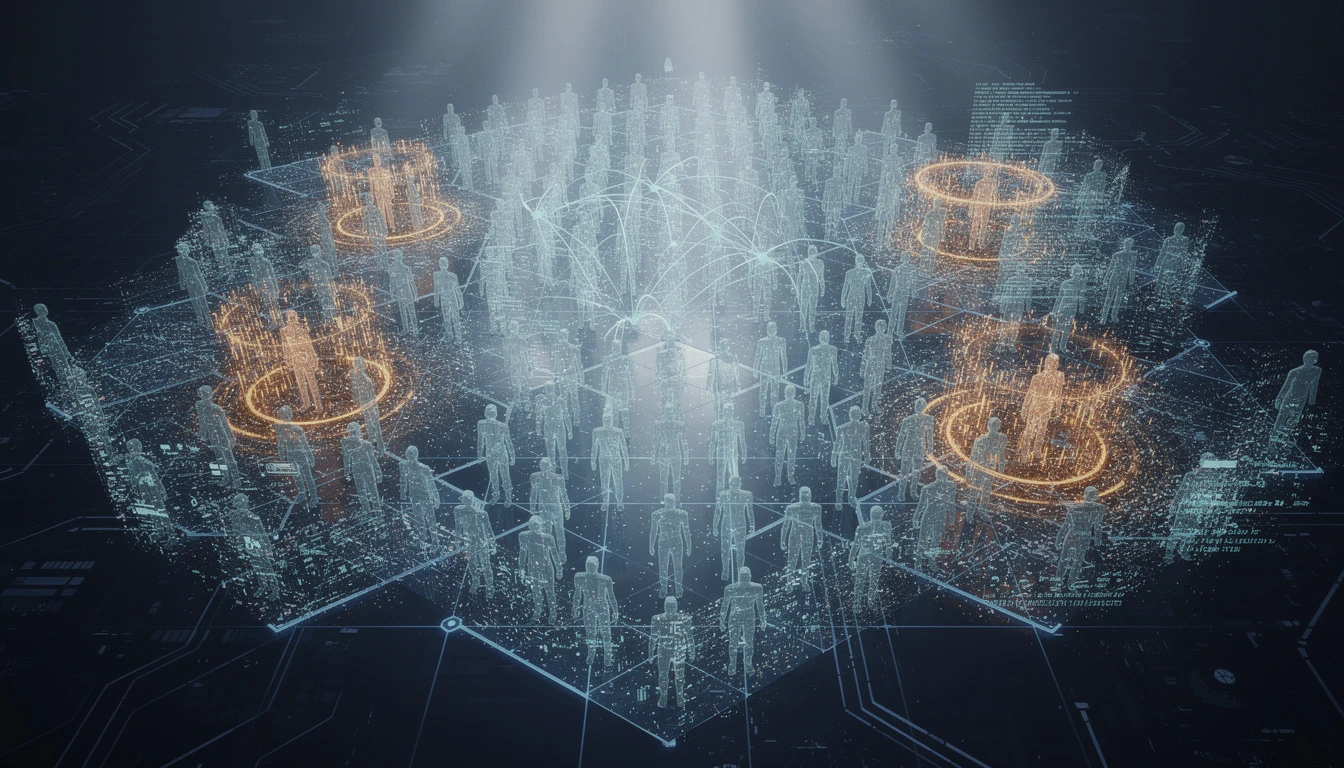
Group-IB's 2026 High-Tech Crime Trends Report documents something that intelligence practitioners have been watching build for three years: the industrialization of synthetic identity. Persona kits — complete digital identities with seeded social history, behavioral profiles, and platform-specific credentials — are now available on dark web marketplaces for as little as five dollars each. At that price point, deploying ten thousand convincing fake humans is a procurement decision, not a technical challenge.
The consequences for traditional verification are terminal. Every identity check designed around the assumption that a person must demonstrate they are who they claim to be — email confirmation, phone verification, document upload, behavioral CAPTCHA — was built to screen out the occasional bad actor, not to operate against an adversary running an automated production line of synthetic personalities. When the attack surface is ten thousand coordinated accounts, each one passing individual verification with its own unique device fingerprint, IP address, account history, and posting style, the verification layer ceases to function as a meaningful control.
The detection problem has moved. The question is no longer who is this account? It is how does this account behave, relative to everything around it? That is a fundamentally different analytical task — and it requires a fundamentally different kind of platform to execute it.
What a Persona Army Actually Looks Like
The term "persona army" suggests something monolithic, easy to spot. In practice, sophisticated operations are engineered to look like nothing at all. Individual accounts are indistinguishable from genuine users at the point of account inspection. Each has a plausible creation date. Each has a posting history seeded across months or years. Each uses natural language generated by models trained specifically to avoid statistical signatures of AI authorship. Each operates from a geographically consistent IP cluster. Inspected individually, each one passes.
The operational architecture only becomes visible when you look at all of them simultaneously — and specifically when you look at the relationships between their behaviors rather than the content of their profiles. Persona armies have coordination patterns that individual humans do not produce. They respond to stimuli collectively. They amplify each other in sequences too fast for human reading speed. They go quiet in patterns that correspond to off-hours for a specific timezone, even when their stated locations span a dozen countries. They share language entropy signatures — statistical regularities in sentence structure and vocabulary distribution that persist even across models trained to mask them.
None of these signals are visible in a single-source query. Each requires data from multiple platforms and sources, correlated at the behavioral level, evaluated against population baselines established from genuinely organic activity. This is not an OSINT task in the traditional sense. It is an intelligence fusion task — and it requires the architecture to match.
There is a further structural weakness in commoditised persona kits that operators rarely account for. A five-dollar kit is not sold once — it is sold to dozens or hundreds of buyers simultaneously. The same synthetic identity may be running concurrently in a disinformation campaign, a cryptocurrency fraud operation, and a dark web market manipulation scheme, each operated by a different buyer with no knowledge of the others. The operational security implications are significant: a persona burned in one buyer's campaign — detected, flagged, and documented — becomes a known signature that exposes every other deployment of the same kit. More immediately useful for investigators: a persona surfacing across two unrelated campaigns is itself a high-confidence detection signal. Cross-campaign entity resolution — recognising the same synthetic identity appearing in different operational contexts — is a capability that single-source and single-campaign investigation cannot produce. It requires a platform that correlates across multiple simultaneous investigations, not just the one in front of the analyst.
Behavioral Pattern Detection: From Who to How
The shift from identity verification to behavioral pattern analysis requires investigators to stop asking questions that produce binary answers — real or fake, verified or unverified — and start asking questions that produce statistical distributions. An account is not human or not-human. An account's behavior is more or less consistent with human-generated activity across a defined set of parameters. The investigation question is not whether the account passes a check; it is how far its behavioral signature deviates from population norms across multiple dimensions simultaneously.
The most operationally reliable behavioral signals:
Activity cycle analysis. Genuine human accounts have sleep cycles. They have weekday-weekend variance. They have periods of concentrated activity that correspond to commute patterns, lunch hours, and evening leisure. Synthetic accounts, even when configured to simulate human schedules, produce activity distributions that deviate from these patterns in characteristic ways — often showing too-perfect scheduling regularity, or artificial gaps that correspond to server maintenance windows rather than human behavior. No single account's sleep pattern is diagnostic. When five hundred accounts in a purported organic network all show the same anomalous activity distribution, the signal is unambiguous.
Language entropy profiling. Large language models produce text with statistical regularities that persist across stylistic variations. Sentence length distributions, vocabulary breadth relative to posting volume, syntactic complexity variance, and response latency patterns all carry signatures that differ between human-generated and model-generated content. These signatures are not obvious to human readers — they require statistical analysis across a corpus of posts, evaluated against baseline distributions from confirmed organic accounts in the same context. A fusion platform that can ingest, normalize, and statistically analyse posting corpora across hundreds of accounts simultaneously can surface entropy anomalies that are invisible to manual review.
Cross-account coordination timing. Organic social networks amplify content at speeds that reflect human reading and decision-making cycles — typically measured in minutes for initial shares, hours for secondary propagation. Persona armies amplify content in milliseconds. The inter-account response latency in a coordinated network is a near-infallible signature of automation, because it reflects machine execution speed rather than the time it takes a human to read something and decide to share it. Mapping response latency distributions across a suspected network — visualized as a temporal graph rather than a flat account list — makes coordination visible that content analysis cannot find.
Social graph seeding anomalies. Synthetic accounts are typically seeded with follower relationships to establish credibility. These seeding patterns leave structural signatures in the network graph: clusters of mutual follows created within narrow time windows, follower acquisition rates that are inconsistent with the account's apparent age and posting volume, connection patterns that trace back to common infrastructure despite diverse apparent profiles. Entity resolution across the social graph — linking accounts through their network topology rather than their stated identities — surfaces these clusters even when individual accounts have been carefully isolated.
The detection of a persona army is not a question of finding the bad accounts. It is a question of finding the bad network — the invisible structure of coordination that the accounts are embedded in, which only becomes visible when you can see all of them at once.
Dark Web Real-Time Alerts: Closing the Production Window
The five-dollar persona kit does not materialize from nothing. It is assembled from breached credential databases, scraped social media archives, AI-generated profile content, and synthetic behavioral histories — all of which have supply chains that flow through dark web infrastructure. The components of a persona army operation are visible before the operation launches, to any platform monitoring the right sources in real time.
In 2026, the window between a data breach and its dark web commercialization has compressed to hours. Credential sets from a fresh breach appear on onion marketplaces within a day of the breach being executed — sometimes faster, when the attacker is operating a pre-arranged sale. Persona kit builders source from these fresh datasets to give their synthetic identities verifiable personal information: real names, real addresses, real historical account associations that pass validation checks designed to catch fabricated data.
This supply chain is the detection opportunity. Real-time monitoring of dark web marketplaces and forums — tracking the appearance of new credential datasets, new persona kit listings, new tooling for identity synthesis — creates advance warning of persona army infrastructure before it is deployed. An agency that observes a bulk listing of credential datasets matching a specific demographic or geographic profile has time to alert relevant platforms, rotate compromised credentials, and prepare detection signatures before the operation reaches operational scale.
The practical value extends beyond early warning. Dark web monitoring of persona kit marketplaces reveals the operational signatures that the kits produce — the specific behavioral templates, language model configurations, and account seeding patterns that a given kit generates. This intelligence feeds directly into detection tuning: if you know what a specific kit's output looks like statistically, you can build detection rules that identify deployments of that kit across monitored platforms with high precision.
The critical requirement is real-time collection. A monitoring cycle that reviews dark web sources weekly is operationally useless against a threat that moves in hours. The platform needs persistent stream monitoring across dark web infrastructure — not periodic scraping — so that new listings surface as alerts rather than appearing in a weekly report after the window has already closed.
The OSINT/Hacking Border in 2026
The same AI tools that make persona army detection operationally feasible also make it trivially easy for investigators to cross from legitimate open-source intelligence into territory that is illegal in most jurisdictions. This is not a theoretical concern. It is a daily operational risk in 2026, and it has become acute as the capabilities gap between what is technically possible and what is legally permissible has widened.
The legal line has not moved significantly in most jurisdictions, even as the technical line has shifted dramatically. Data that is technically accessible through AI-powered scraping, automated credential testing, or inferred private information is not necessarily public data in any legally meaningful sense. The EU's GDPR, Singapore's PDPA, and equivalent frameworks in most operating jurisdictions impose obligations on data that is collected, processed, or stored — regardless of whether it was technically accessible. An investigator who collects personal data through methods that do not meet the lawful basis requirements of applicable law has not conducted OSINT; they have conducted an unlawful data collection that may be inadmissible in court and may expose their agency to legal liability.
The practical boundary in 2026: passive collection from genuinely public sources, with documented legal authority and clear investigative purpose, remains lawful OSINT. Active methods — creating accounts to access restricted content, automated testing of authentication systems, inference of non-public data from public signals — cross into territory that requires specific legal authority in most jurisdictions and constitutes illegal access without it.
For intelligence platforms, this means that compliance provenance — the documented chain of authority, method, and lawful basis for each data element — is not an administrative function. It is an operational requirement. Evidence derived from unlawfully collected data is inadmissible. Investigations built on inadmissible evidence collapse at prosecution. A platform that tracks the collection method and legal basis of each data element throughout the fusion pipeline protects both the investigation and the agency — not as a bureaucratic safeguard, but as a direct operational capability.
The Scale Requirement
Persona army detection at meaningful scale cannot be a human-intensive operation. The arithmetic does not work. An analyst reviewing individual accounts, running manual queries across each platform, building network graphs by hand — this model was adequate when the adversary's capacity was constrained by the cost and difficulty of creating convincing fake identities. At five dollars per identity, the adversary can outpace human review indefinitely.
The detection task requires machine-speed processing of behavioral signals across thousands of accounts simultaneously, correlated against population baselines derived from millions of data points, with alert logic that fires when statistical anomalies exceed defined thresholds — without an analyst manually initiating each query. It requires dark web monitoring that runs continuously, not on a review schedule. It requires entity resolution that links accounts through behavioral and network signals rather than stated identity. It requires compliance logic that evaluates each data element against applicable legal frameworks as it enters the pipeline, not as a post-collection review step.
These are not features that can be added to a search-based intelligence platform. They require a native architecture built around the assumption that the adversary is operating at machine scale — and that the defense must match it. The agencies that are positioned to detect persona army operations in 2026 are those that treated behavioral fusion and dark web stream monitoring as platform requirements, not optional capabilities. The agencies still relying on query-based investigation and weekly review cycles are not losing ground gradually. They are operating in a threat environment that has already moved past the model they are using.